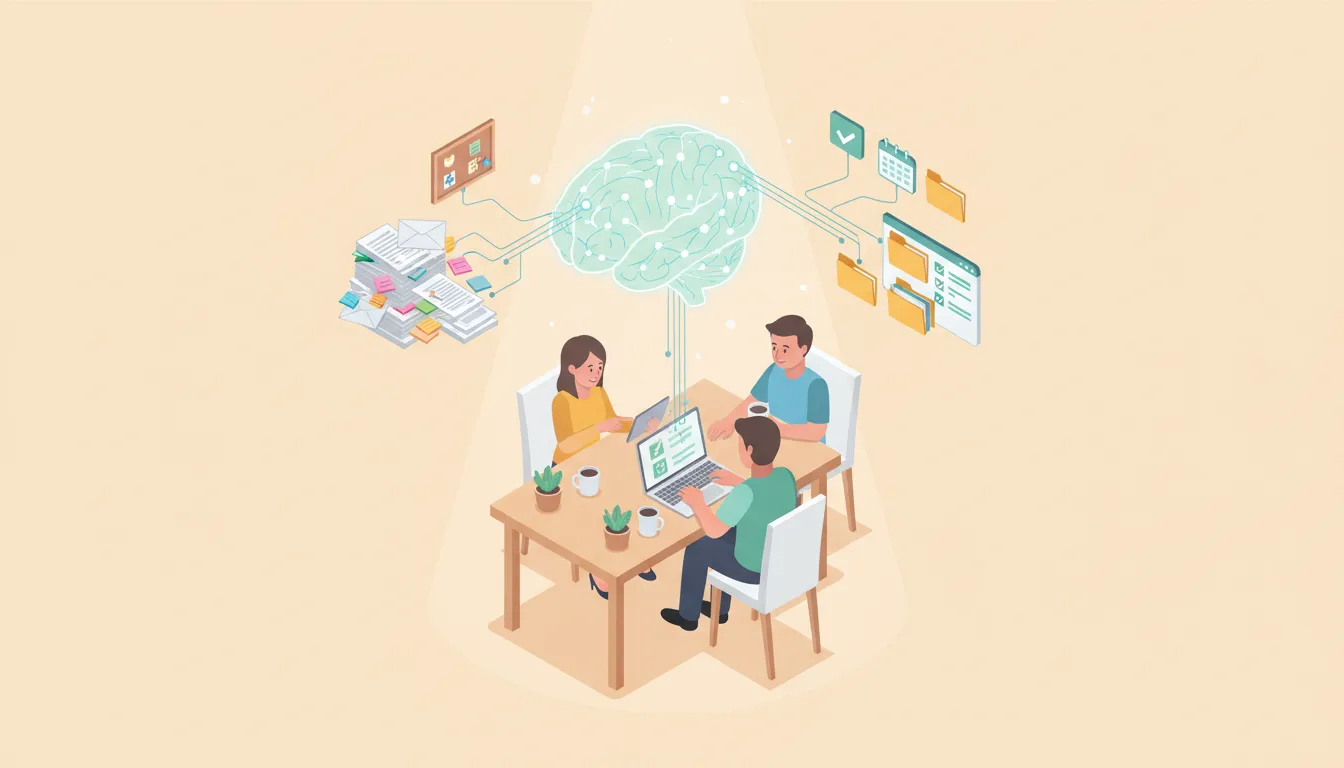
Information is no longer the scarce resource. Attention is. Small teams and nonprofit organizations face the same tidal wave of emails, files, meeting notes, and ideas as large corporations—often with fewer people, less time, and tighter budgets. The difference between a frantic office and a productive one is not more hours; it is how you manage information so it becomes useful rather than exhausting.
The problem: too much information, too little attention
Modern knowledge work overloads our five senses with more content than our brains evolved to process. Imagine consuming the equivalent of dozens of newspapers every day while also juggling donors, customers, volunteers, and project deadlines. That constant stream consumes your most precious resource: attention.
An abundance of information creates a poverty of attention.
That observation captures the real issue. For small teams, the result is missed follow-ups, duplicated work, inconsistent messaging, and the slow drift of institutional knowledge out the door when someone moves on.
Why the smartest people kept commonplace books
For centuries, creative minds kept a single place to collect what mattered: quotes, observations, sketches, recipes, and lessons. These commonplace books were not diaries. They were curated repositories of meaning—personal libraries that grew into the raw materials for ideas that later became art, science, leadership, and policy.
The lesson is straightforward: when information is everywhere, the antidote is a disciplined place to save and reuse what matters. For small businesses and nonprofits, that place becomes the backbone of continuity and creativity.
What is a second brain?
A second brain is a personal system for knowledge management. It is an intentional practice that captures useful information, organizes it so it can be found, distills it down to its essential value, and expresses it as work you can share or act on.
A well-built second brain removes the need to keep trying to remember everything. It gives teams a shared memory and makes it possible to move from reactive firefighting to deliberate, creative work.
The CODE framework: a practical creative process
CODE is a simple, portable framework that mirrors how ideas actually move from raw input to finished output. It stands for:
- Capture — collect what matters
- Organize — put it where it will be useful
- Distill — make the meaning obvious
- Express — create outputs that move the organization forward
Capture: what small teams should save
Capture is not about saving everything. It is about saving the things that are most likely to help later. Use four practical filters:
- Inspiration — anything that evokes a feeling you want to reproduce (photos, lines from a speech, a campaign headline that landed).
- Practical details — specs, vendor contacts, form templates, or the exact wording a funder requested.
- Personal lessons — what your team learned from a failed event, a successful campaign, or a volunteer interaction.
- Surprising insights — novel ideas or counterintuitive facts that made you pause; these often seed creative connections.
For nonprofits, capture might include a donor's preferred recognition language, a local vendor's billing cadence, or an unexpected community insight from a listening session. For a small business, it might be a screenshot of a competitor's pricing table, a customer quote that reveals a need, or a prototype image.
Practical capture habits for small teams
- Designate a lightweight app or notebook everyone uses for raw capture.
- Create simple templates: meeting notes, campaign brief, incident report.
- Encourage quick captures: a photo of a receipt, a voice memo after a donor call, a screenshot of a relevant post.
- Make capture communal: a shared folder for incoming ideas and evidence.
Organize: PARA, not folders nested forever
Organization should reduce thinking, not increase it. The PARA system is purpose-built for clarity: Projects, Areas, Resources, Archives.
How PARA maps to small organizations:
- Projects: short-term efforts with a clear outcome and deadline — the next fundraising drive, a product launch, the annual report.
- Areas: ongoing responsibilities you maintain — donor stewardship, payroll, board governance, customer support.
- Resources: topics and reference materials you consult — marketing ideas, grant templates, design inspiration.
- Archives: inactive items kept for legal or historical reasons — past proposals, completed campaigns, old tax records.
The principle is simple: keep what you need to act now close at hand; everything else goes into progressively less-visible places. Projects win priority because they are the hot pans on the stove.
How PARA helps small teams
- Reduces cognitive load: focus on immediate tasks while preserving context for later.
- Improves onboarding: new hires can access relevant Projects and Areas instead of piecing together scattered files.
- Supports accountability: clearly labeled Areas reveal who owns what.
- Makes reuse easy: Resources become a go-to library of templates, case studies, and inspirations.
Distill: find the signal in the noise
A note without a takeaway is a fossil. Distillation is the habit of extracting the most useful point from a source and highlighting it so your future self can act quickly.
Two high-impact practices:
- Highlight the main idea — write a one-line headline for every note: the single most useful fact, question, or action.
- Create handles — think of these headlines as handles you can grab. When you're under a deadline, handles get you moving fast.
Distillation dramatically increases discoverability. Search helps you find notes; highlights help you scan and decide within seconds which ones to use.
Express: three stages that turn notes into impact
The ultimate purpose of keeping a second brain is to express ideas that create value. Expression progresses through three stages:
- Remembering: retrieving a single fact or example to strengthen a point in a meeting.
- Connecting: combining notes from different places to form a new insight or proposal.
- Creating: producing a finished artifact — a campaign, grant application, product, or strategy — that can be shared and iterated.
For a small nonprofit, remembering could be pulling up the phrasing that persuaded a major donor; connecting could be synthesizing community feedback into a program redesign; creating could be publishing a compelling case for support that draws in new funding.
Divergence and convergence: when to open the doors and when to close them
Creativity and delivery are two different motions. Divergence is the expansive phase: gather ideas, examples, and inspiration. Convergence is the reductive phase: choose, implement, and ship.
Successful projects swing between these modes. The trick is to be deliberate about which mode you are in:
- Divergent work benefits from wide exposure: conversations, browsing, and collecting examples.
- Convergent work benefits from constraints: time boxes, clear scope, focused execution.
If you are forever researching and never finishing, apply constraints: limit the number of options you’ll consider or set a strict research time budget. Conversely, when you feel stuck on a project, switch to divergence for an hour to collect fresh examples and rekindle momentum.
Practical workflows for small businesses and nonprofits
A second brain becomes powerful only when it supports repeatable workflows. Here are concrete examples you can implement today.
1. Donor stewardship workflow (nonprofit)
- Capture: after each donor conversation, capture the exact phrasing donors use about their motivation and interests.
- Organize: store these notes under the donor's profile in your CRM (Project: current campaign; Area: donor stewardship; Resource: donor insights).
- Distill: add a one-line headline: "Joan prefers unrestricted gifts; loves stories about youth programs."
- Express: use the headline to personalize the next email or proposal, and attach relevant impact stories from your Resources folder.
Benefits: higher response rates, stronger relationships, and faster, more consistent donor follow-up even when staff turnover occurs.
2. Campaign creation workflow (small business)
- Capture: save screenshots of effective competitor ads, customer testimonials, and high-performing subject lines.
- Organize: create a Project folder for the campaign and drop active research into it; move inspiration to Resources.
- Distill: write three headlines and the single conversion metric you’re optimizing for.
- Express: assemble the first draft of copy using your distilled headlines and run a small A/B test.
Benefits: faster iteration, re-usable templates, and building a searchable archive of marketing experiments.
3. Volunteer onboarding and SOPs (both)
- Capture typical volunteer questions and pain points during training sessions.
- Organize a living Area called "Volunteer Operations" with checklists and quick-start guides.
- Distill into one-page SOPs that lists "must-do today" actions.
- Express by turning SOPs into short videos or printable one-sheets volunteers can use in the field.
Benefits: reduced mistakes, faster onboarding, and the ability to scale your operations without hiring.
Tools, habits, and low-cost options
You do not need an expensive stack to start. The important part is consistency, not complexity.
- Capture tools: smartphone camera, voice memos, Slack, or a shared Google Doc for quick captures.
- Organize tools: a simple folder system in Google Drive or Dropbox using PARA naming; or a notes app like Notion, Evernote, or similar.
- Distill tools: highlight features in your app, or create a single-line summary in the first line of each note.
- Express tools: templates in Google Docs, email templates, Canva for quick graphics, and inexpensive webinar tools for storytelling.
The only ongoing cost that matters is time. Block 15 minutes at the end of each day to move any loose captures into the right Project, Area, or Resource and add a headline. That daily habit is more valuable than perfect structure.
Convergence tactics that actually get things finished
Three techniques reduce friction as you move from idea to delivery.
Hemingway Bridges
End each work session by writing one sentence that starts the next session. This small bridge eliminates the blank page problem and dramatically speeds re-entry.
Dial down scope like engineers
When deadlines loom, drop features or nonessential parts rather than delaying the date. Save removed pieces to Archives. This maintains momentum and ensures core value ships on time.
Break work into small saved steps
Break large tasks into micro-steps and save these steps in your Project note. Each micro-step becomes a clear next action that can be completed in a short session.
Seasons of use and realistic limits
A second brain is not a religion. It is a tool that is more useful in some seasons than others. During periods of massive change—new hires, a new office, launching a program—you will capture and create a lot. During quieter seasons you will harvest and iterate.
Also be mindful of presence. When you meet donors, volunteers, or staff face to face, sometimes presence matters more than perfect documentation. A practical compromise is to take notes on paper during the meeting and photograph the page into your system afterwards.
Adopting a second brain as a team
For small organizations, the biggest gains come from shared norms rather than strict rules. Start with a minimal set of conventions:
- One agreed capture tool for quick, on-the-go inputs.
- Shared PARA folders with clear naming conventions.
- Daily or weekly 15-minute tidy sessions where team members file loose notes into Projects and add headlines.
- Quarterly reviews to move obsolete Projects into Archives.
Training is simple and high-impact. Teach people three moves: capture quickly, add a headline, and file into PARA. Those three actions create outsized returns.
Why this matters for small businesses and nonprofits
The ability to collect and reuse knowledge is the difference between repeating the same mistakes and accelerating growth. A second brain preserves institutional memory when staff turnover happens, reduces duplication, increases consistency in donor and customer communications, and frees attention to do the creative work that actually moves the mission forward.
Technology is democratizing capability. A small nonprofit with a lean team can perform like a much larger organization when it treats knowledge as an asset and centralizes it so ideas are reusable and visible.
Future thinking and education
Expect second brain practices to become mainstream. The missing link historically has been education. If these practices were taught in college or staff onboarding, teams would waste far less time learning by accident. Until then, small organizations that adopt these building blocks early get a practical advantage.
Limitations and mindful use
Any tool can become a crutch. Periodically experiment by stepping away: a day without your phone, a day without new captures, or a short digital fast. These experiments reveal what truly adds value and what merely fills time.
Ultimately, a second brain is a means to live and work with more meaning, not to substitute living. If it frees up time and attention to care for people, refine the mission, and deepen relationships, it is working.
Quick-start checklist for a small team
- Pick one capture tool everyone can access (phone, shared doc, Slack channel).
- Create PARA folders in your shared drive.
- Agree on one-line headlines for notes; add them as the first line.
- Commit to a 15-minute daily or weekly tidy session.
- Use Hemingway Bridges: end sessions with a one-line next step.
- When deadlines loom, dial down scope and archive what you remove.
Case study snapshot
A small arts nonprofit used a second brain approach to stabilize volunteer operations and increase fundraising. They centralized volunteer how-tos and donor notes in a shared PARA structure, created one-page SOPs distilled from captured experiences, and trained staff to use headlines. The result: a 30 percent reduction in onboarding time for volunteers, higher donor retention, and a smoother handoff when staff changed roles.
Final thought
Creativity is not a mystical resource reserved for a few. It is a process you can design. A second brain is simply the set of habits and structures that let you spend less time searching and more time connecting and expressing. For small businesses and nonprofits, that means more time serving customers and communities, and more impact with the same resources.
FAQ
How quickly can a small team get value from a second brain?
Within days. Start by centralizing meeting notes and donor or customer details into a single shared place. Add one-line headlines and file into Projects. Even a brief tidy session each day will show immediate reductions in duplicated work and faster responses.
Which tools work best for nonprofits and small businesses?
Use what your team already has. Google Drive plus a simple notes app can be enough. If you want more structure, low-cost tools like Notion, Evernote, or simple CRMs can work. The tool matters far less than consistent habits.
How do we prevent the second brain from becoming another inbox to check?
Build tiny rituals: a 15-minute filing session, headlines as the first line of notes, and PARA to keep active items visible. Discipline converts the second brain from noise into a productivity amplifier.
What should we capture for grant writing?
Save funder guidelines, successful proposal language, impact metrics, beneficiary stories, budget line items, and past feedback. Distill these into short headlines that answer “What does this funder care about?” and “Which evidence supports impact?”
Can these practices help with volunteer retention?
Yes. Capture volunteer preferences, scheduling patterns, and training gaps. Organize one-page SOPs and quick-start guides. When volunteers feel supported and tasks are clear, retention improves.
How does PARA differ from traditional folder systems?
PARA organizes by actionability and timeframe rather than topic depth. Projects and Areas focus on what needs attention now or over time, Resources keep learning and inspiration, and Archives store inactive items. It reduces decision friction on where to look for what you need.
How often should we review and archive items?
Schedule a quarterly review. Move completed Projects to Archives and prune Resources that are no longer relevant. Regular pruning keeps the system lean and trustworthy.
What if our organization has low tech skills?
Start simple. Paper captures photographed into a shared folder, spreadsheets for basic tracking, and a short workshop on headlines and filing will go a long way. Peer modeling and small wins build confidence.
How do we balance capture with being present in meetings?
Prioritize presence. Take paper notes in sensitive one-on-one meetings and photograph or transcribe them later into the system. The relationship is more important than moments of perfect documentation.
Will a second brain replace creativity?
No. It amplifies creativity by freeing attention, preserving ideas, and making connections more likely. The most creative work still depends on human judgment and value-driven choices; the second brain supplies the raw materials and momentum.
This article was created based on the video Unlock creative genius like da Vinci and Richard Feynman | Tiago Forte.


