
Strategy and operations alignment is the secret weapon behind every predictable, scalable business. If you want growth that doesn’t feel accidental, you need a visual map of how customers actually move from first awareness to a signed contract. That map is what I call a growth engine. It is the practical foundation for strategy and operations alignment because it turns assumptions into a documented process you can measure, manage, and improve.
Why a growth engine matters for strategy and operations alignment
Most leaders ask the wrong question: how do we get more customers? That is a fine ambition, but it skips the more useful question: how do customers happen in the first place? When you can answer that clearly, you can optimize the steps that already produce results instead of guessing at shiny new tactics.
A growth engine is a visual representation of your customer acquisition process from that first moment of awareness until the sale is closed. Documenting that flow creates clarity across teams. It becomes the single source of truth for marketing, sales, and fulfillment, and it is the core artifact you need for genuine strategy and operations alignment.
The simple tools you need
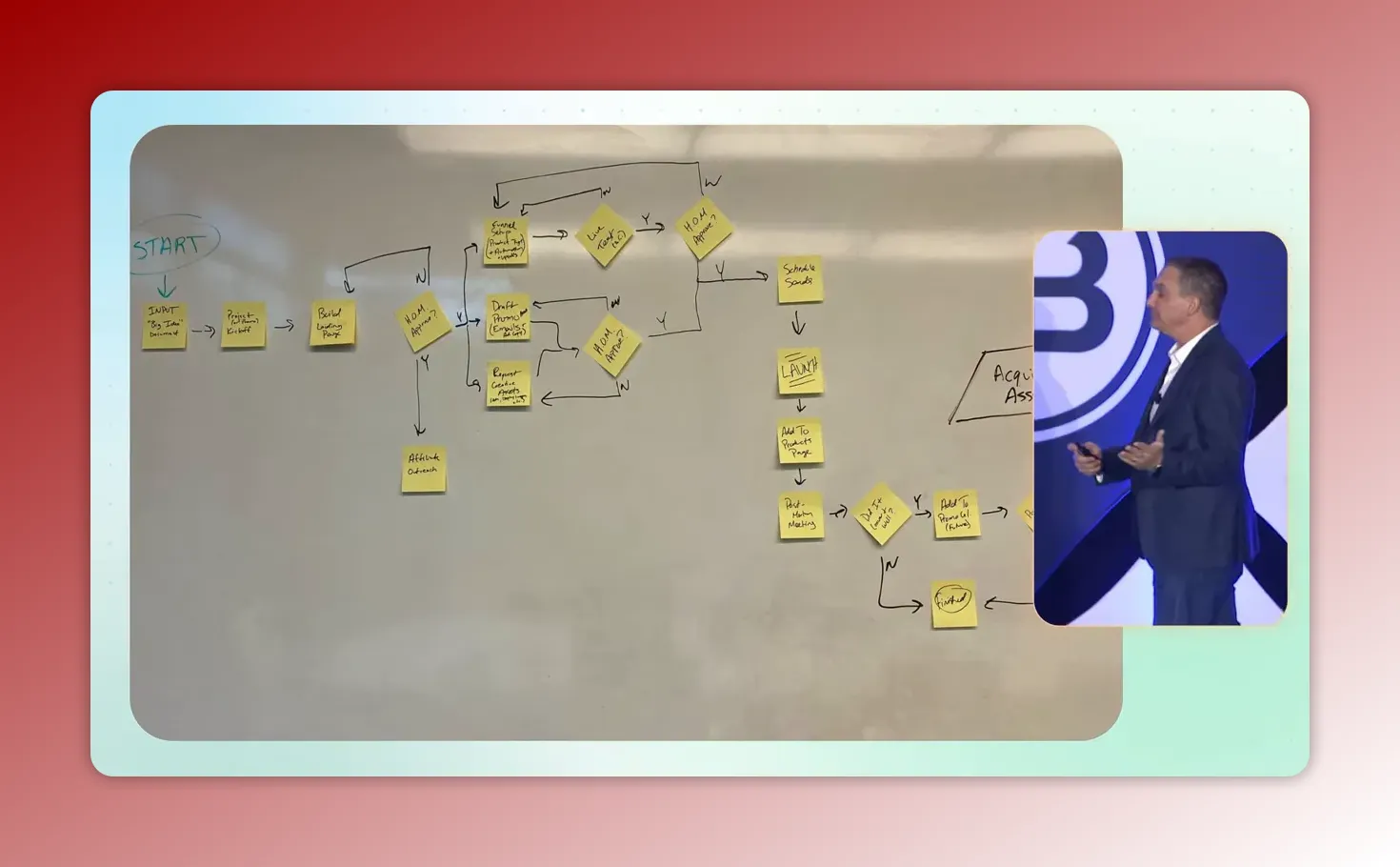
You do not need fancy software to begin. Start with a big whiteboard, a pack of sticky notes (both square and diamond shapes help), and a pen. When it is time to clean up and share, move the diagram into a flowcharting tool like Whimsical, Lucidchart, or Miro. The point is to visualize first, refine second.
Symbols that make the map readable
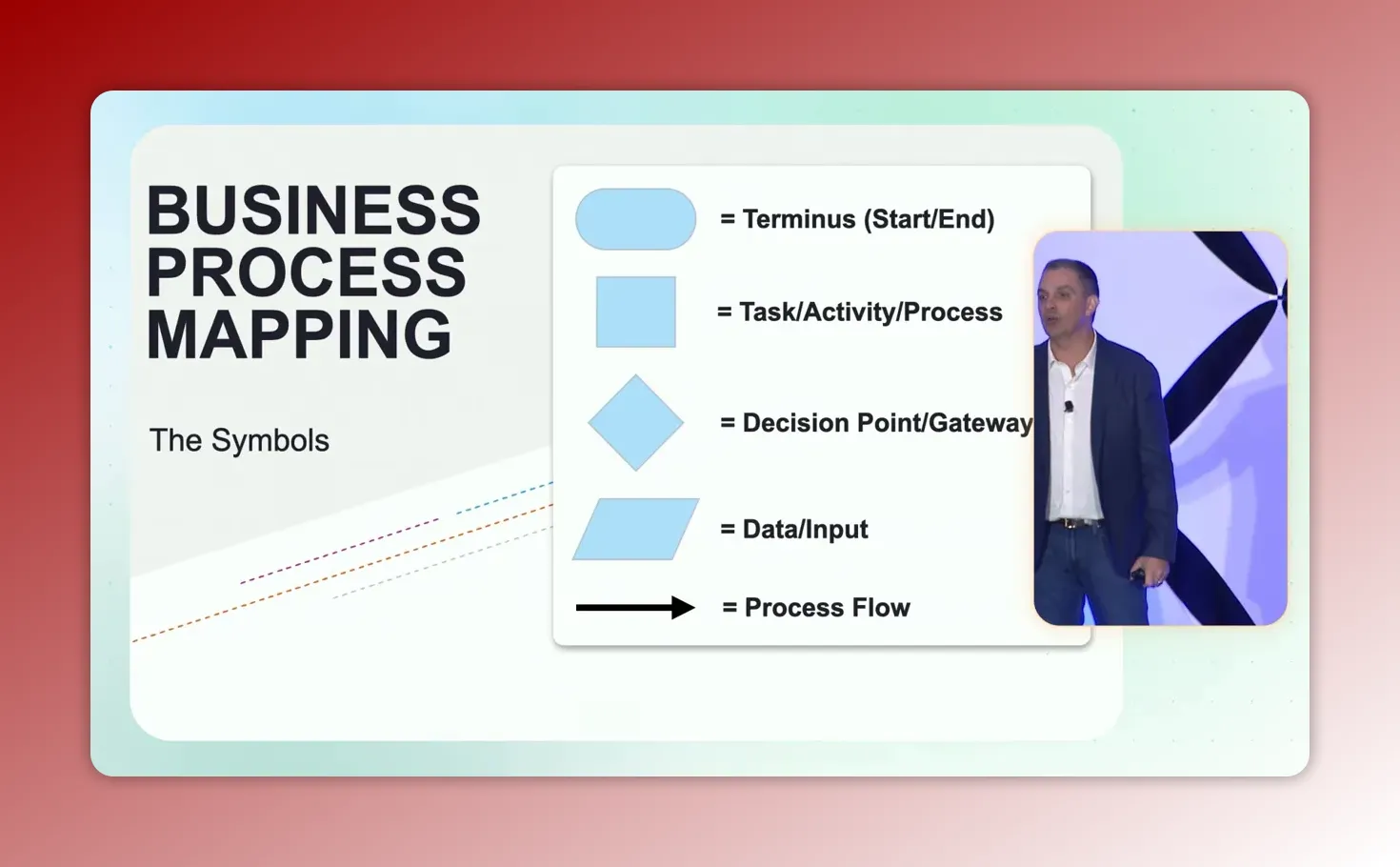
- Terminus (pill shape): Marks the start and end points. Write START in the upper left and draw a pill around it.
- Square: A task, activity, or stage in the process.
- Diamond: A decision gateway. Use a question in the diamond and branch the flow on yes/no answers.
- Parallelogram: A data input or artifact (for example, a lead list or a report).
- Arrows: Show the direction of customer movement from stage to stage.
These five shapes are all you really need to get started. Put them on sticky notes so you can move them around as you discover gaps and orphan activities.
Step 1: Inventory your growth assets
Before you map anything, take a quick inventory. The goal is to capture reality, not theory. Use these six questions as a checklist and write answers on sticky notes.
- What are you selling? Define the core flagship product or service and any related upsells or bolt-ons.
- How do qualified prospects currently find out about your brand? List actual channels you are using today—Facebook ads, Google PPC, radio, inbound calls—don’t list channels you wish you used.
- How are you leveraging content and follow-up marketing? Email newsletters, blogs, podcasts, lead magnets—capture what you actually have in place.
- What lead magnet or opt-in are you offering? What valuable chunk of content gets someone to give you contact permission?
- How do prospects make a micro commitment? Micro commitments are calendar or wallet actions: webinar attendance, demo sign-ups, appointment bookings.
- What are your aha moments? Points in the process that indicate someone is highly likely to convert—examples include a webinar “long launch,” demo engagement, or product sampling.
These artifacts become the sticky notes that populate the left side of your growth engine. If you want true strategy and operations alignment, be brutally honest here. Record what exists.
Step 2: Select the growth engine to map
Most businesses have multiple growth engines. Growth engines are defined by the flagship product or service they support. If your company sells three distinct flagship products, expect three growth engines. For this exercise, pick one flagship product and focus on mapping the engine that delivers that product to customers.
This focus is vital for strategy and operations alignment. When teams know which engine supports which revenue stream, it becomes straightforward to prioritize optimizations and resource allocation.
Step 3: Define the start and the end
Every growth engine has a triggering event and a final event. Define these before you add everything in between.
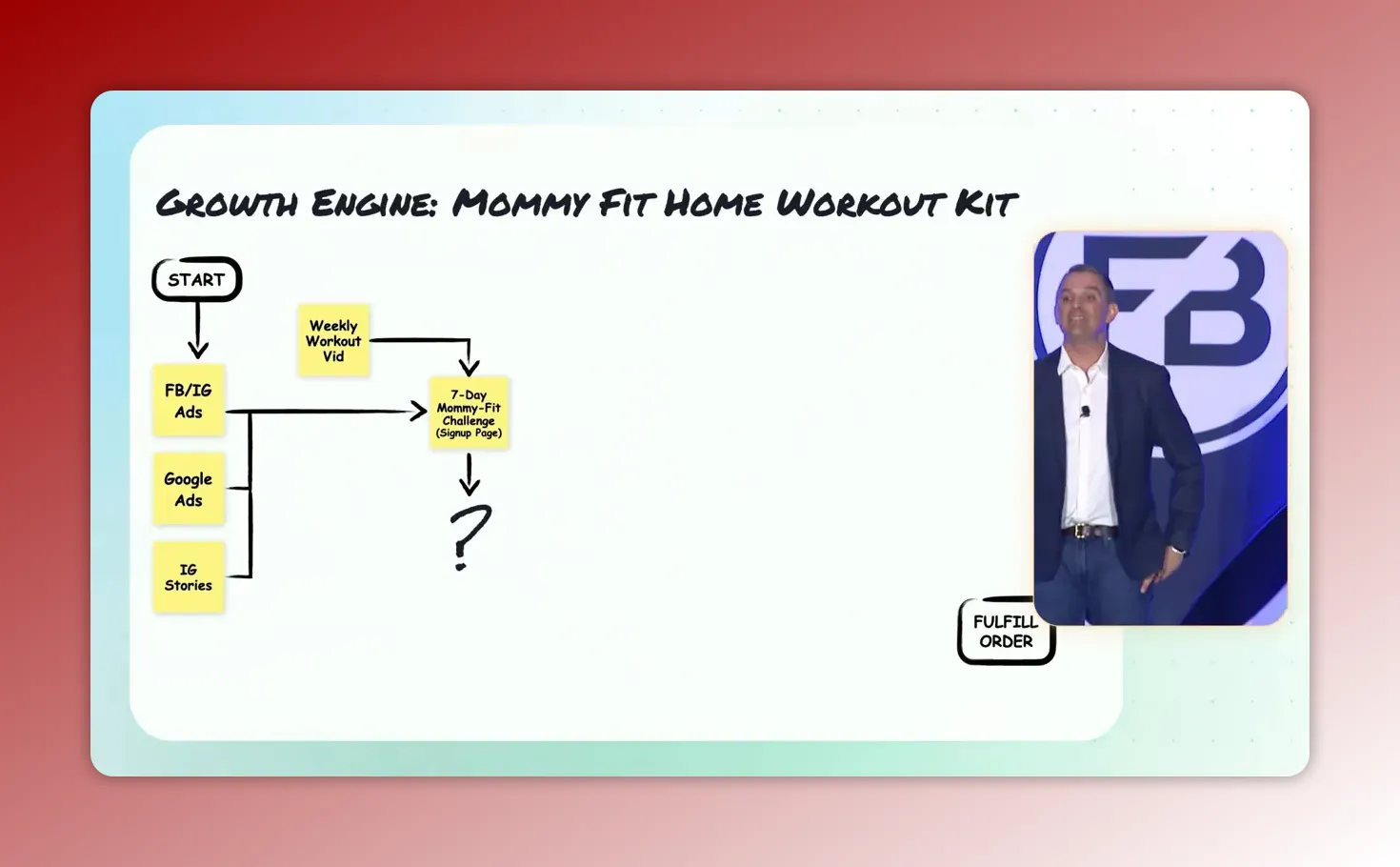
- Triggering event: A visitor clicks an ad. Someone calls the front desk. An inbound lead fills out a form. Put each channel that triggers the engine on its own sticky note.
- Ending event: The contract is signed, or the order is fulfilled. Growth engines stop when the sale is made; fulfillment engines pick up afterward.
Write a START pill in the upper left and an END pill (fulfill order or signed contract) in the lower right. Those two anchors give you the scope and prevent scope creep.
Step 4: Brainstorm tasks and activities between start and finish
Now comes the part most people skip: the connective tissue. What happens immediately after the triggering event? What micro-commitments must be earned? Where do prospects fall out of the funnel? Add a sticky note for every stage, every micro-commitment, and every automated follow-up you actually do.
Expect to find orphan tasks—activities the team executes that do not connect to any measurable output. Identifying and either reconnecting or removing those orphan tasks is one of the highest-impact activities you can do for strategy and operations alignment.
How to think about decision diamonds
Every time the flow could go more than one way, add a decision diamond and phrase the question. For example:
- Did they register?
- Did they click any offer link?
- Did they show up to the demo?
Each yes/no branch is its own path with its own follow-up actions. Use diagonally placed sticky notes to represent those diamonds so the map stays readable.
Example 1: The Mommy Fit growth engine
Imagine a direct-to-consumer fitness brand, Mommy Fit, selling home fitness videos and kits to stay-at-home moms. Their growth engine looks like this in practice—the reality that produced revenue for them.
- Triggering events: Facebook and Instagram ads, Google ads, Instagram Stories and Reels.
- Lead magnet: A free 7-day Mommy Fit email challenge (opt-in).
- Follow-up: Weekly email newsletter plus the 7-day challenge sequence.
- Decision diamonds: Did they register? Did they click the offer? Did they go to the sales page? Did they purchase?
- Post-purchase: Upsell to a deluxe kit and then fulfill the order.
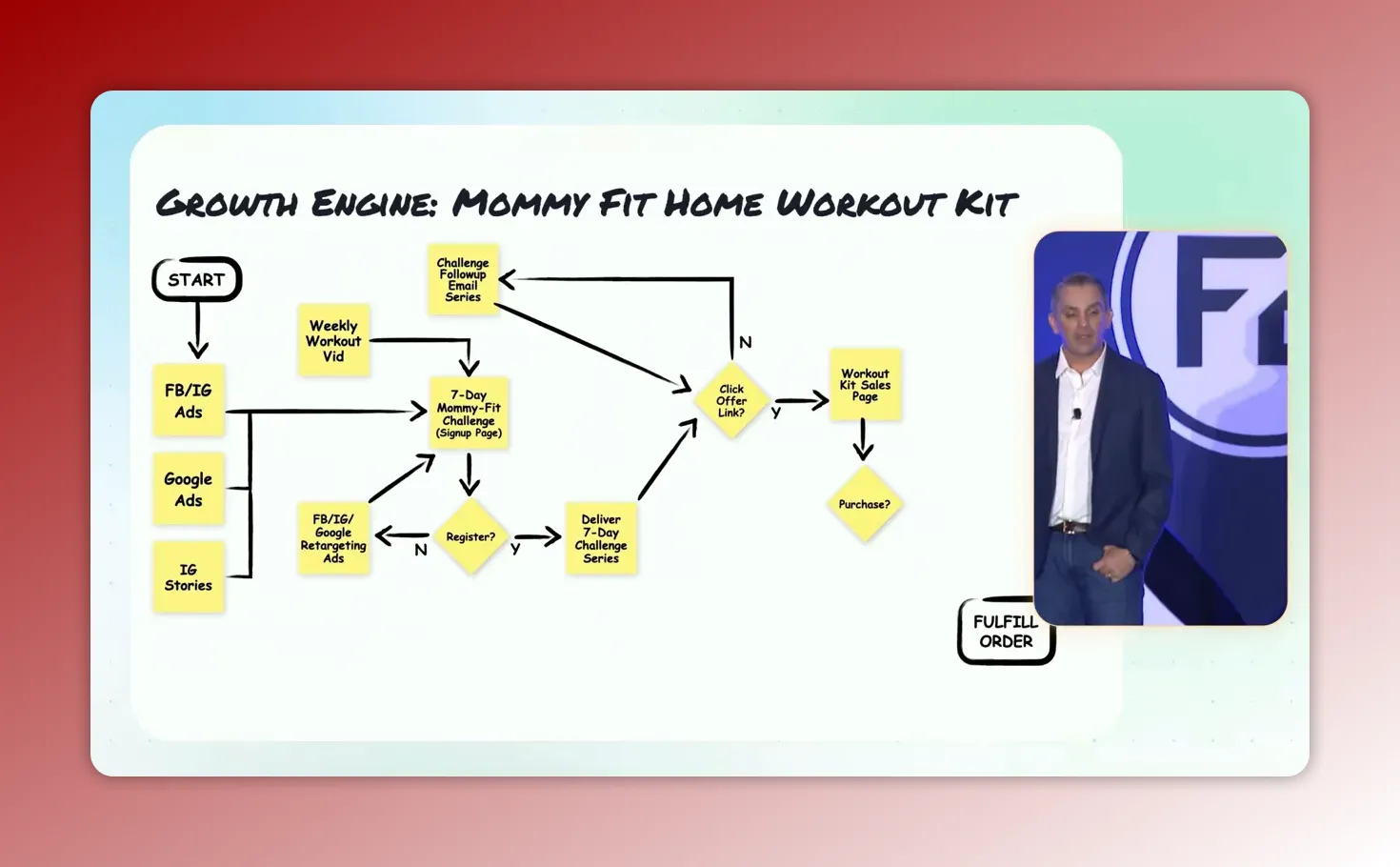
This map shows what they actually did, not what they should do. Once visualized, a dozen optimizations become obvious: add nurture flows for opt-ins that never click, create segmented follow-ups for people who click but don’t purchase, instrument the sales page to run cart abandonment campaigns.
Example 2: A software/services webinar funnel
Now picture an IT services software company that drives traffic to a webinar. Their growth engine was straightforward:
- Triggering event: Facebook and Instagram ads that send people to a webinar registration page.
- Registration follow-up: A webinar registration series to encourage attendance.
- Webinar: Deliver the webinar with a strong call to action to apply to work with the company.
- Decision diamonds: Did they register? Did they attend the webinar? Did they stay through the call to action? Did they apply? Did they show up to the demo?
- Sales path: If they apply and show up, schedule a sales demo and move into fulfillment. If they do not apply, they might be retargeted or re-invited to future webinars.
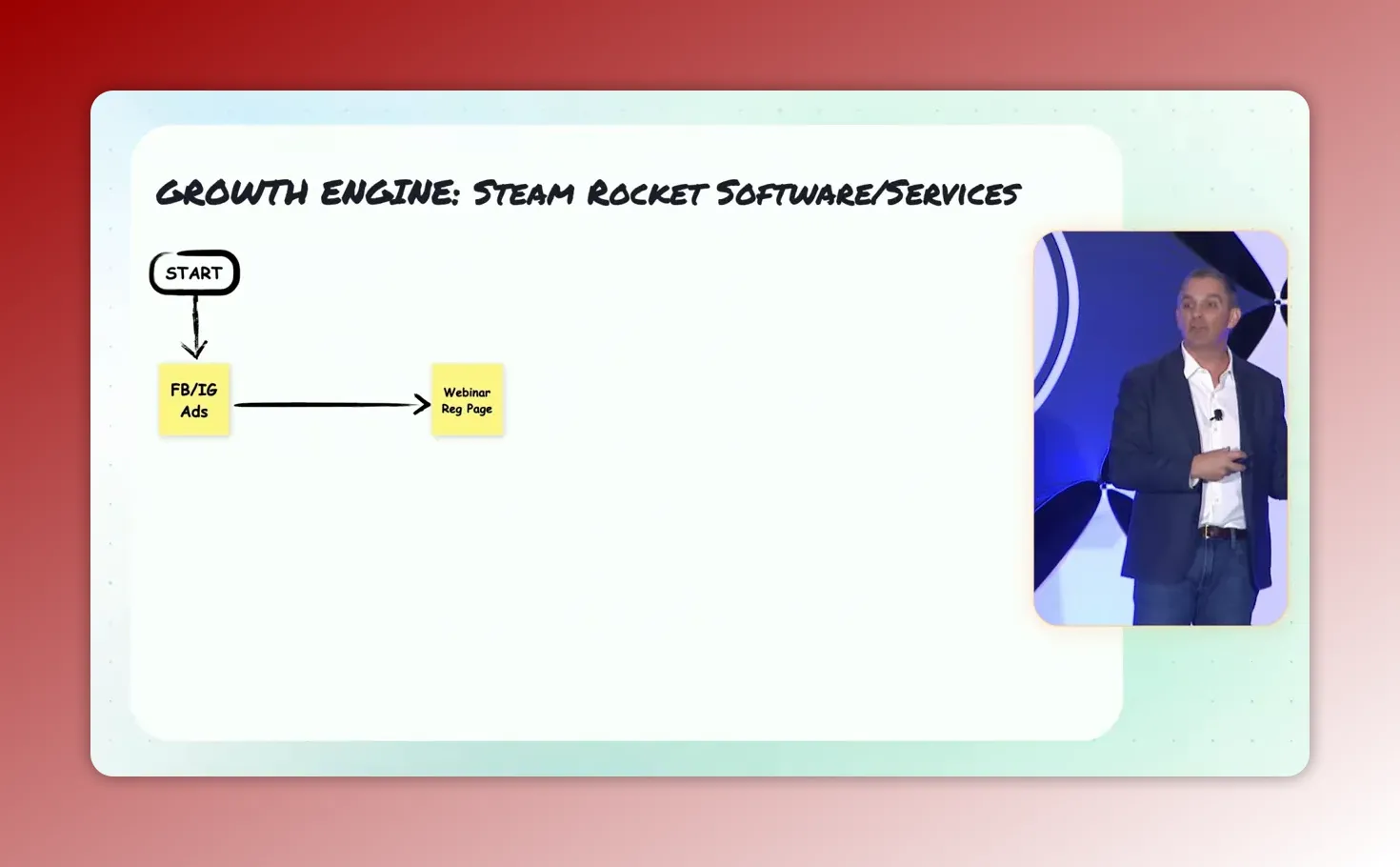
Again, the map showed the company what it actually did: they ran weekly webinars and invited every registrant to the next weekly webinar. That produced $10M a year. It was simple and repeatable. Mapping it highlighted obvious optimizations like following up with no-shows to scheduled demos or proactively assigning sales reps to people who stayed through the CTA but did not apply.
Example 3: Community Dental (a local clinic)
A brick-and-mortar example: a dental clinic running a growth engine for teeth whitening. Their real-world engine included both online and offline triggers:
- Triggering events: Facebook and Instagram ads, Google ads, and radio ads with two calls to action: call the office or visit the landing page.
- Inbound call handling: Front desk scripts that capture name, phone, and email and ask permission to add the caller to the newsletter.
- Confirmation: An appointment confirmation series for booked appointments.
- In-office workflow: Teeth whitening, before-and-after photos, schedule follow-up appointments or upsell aligners or other cosmetic services.
- Post-visit: New patient welcome kit.
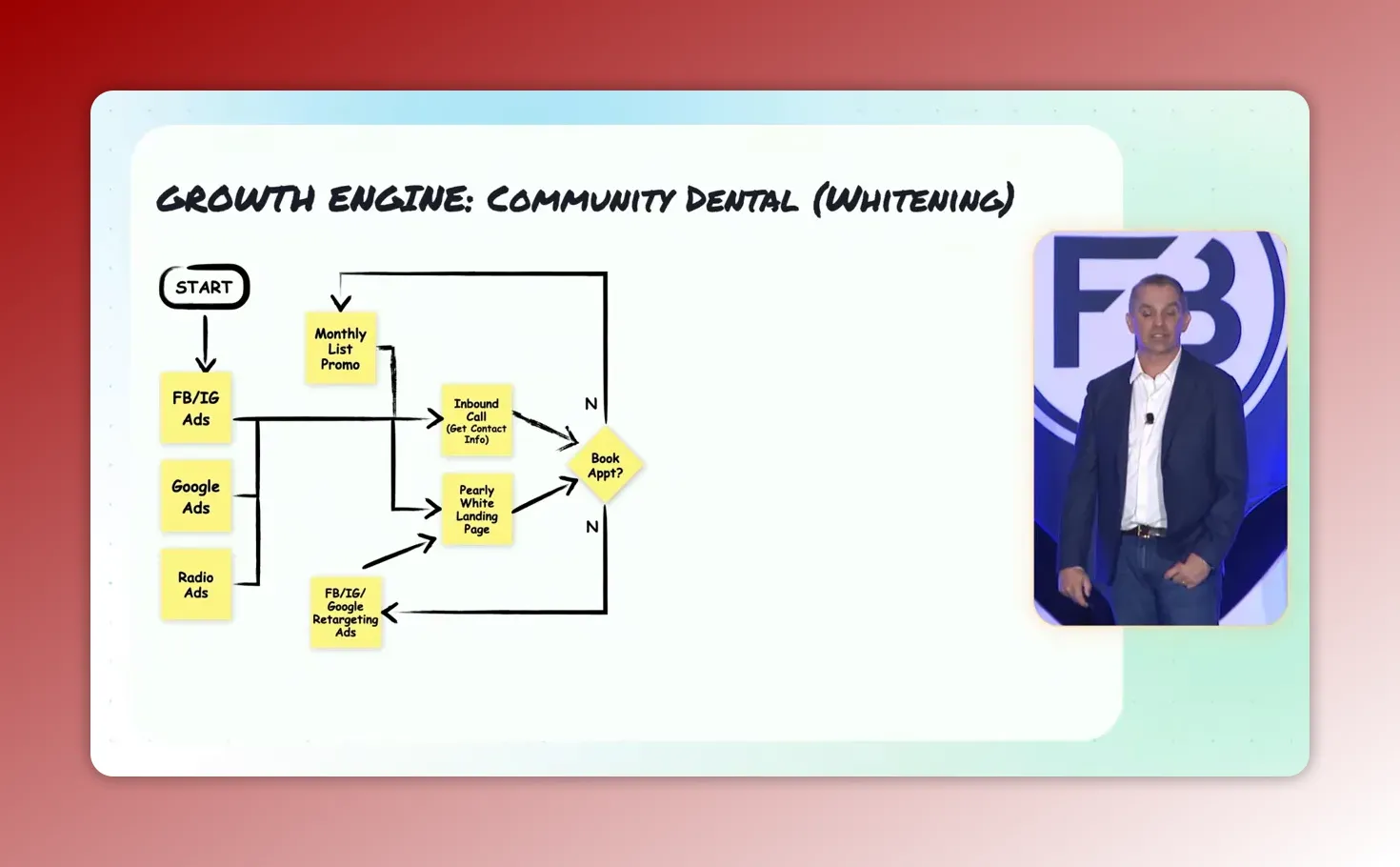
This growth engine made it clear what the clinic needed to measure: ad-to-call conversion, call-to-book conversion, show rates, and post-procedure upsell conversions. If a blog article was being published weekly but did not link to any lead magnet, it did not earn a place on the growth engine until those links were added. That is strategy and operations alignment in practice: every content piece must connect to a measurable path.
Step 5: Stakeholder review
Once you have a draft on the whiteboard, hold a stakeholder review. Bring the people who execute the tasks. Ask them, what are you doing that is not on this chart?
Three things happen during stakeholder review:
- You discover hidden activities the team already does and can celebrate wins.
- You find orphan activities that do not connect to outcomes and either remove them or reconnect them.
- You reveal subprocesses that belong under a larger stage and can be moved into standard operating procedures.
When people see where their work fits into the full journey, they get context. That context sparks ideas, better execution, and higher-quality work because team members can optimize within a clearly defined chain rather than guessing what matters most. That is how you achieve strategy and operations alignment at scale.
Finalizing the map in a flowcharting tool
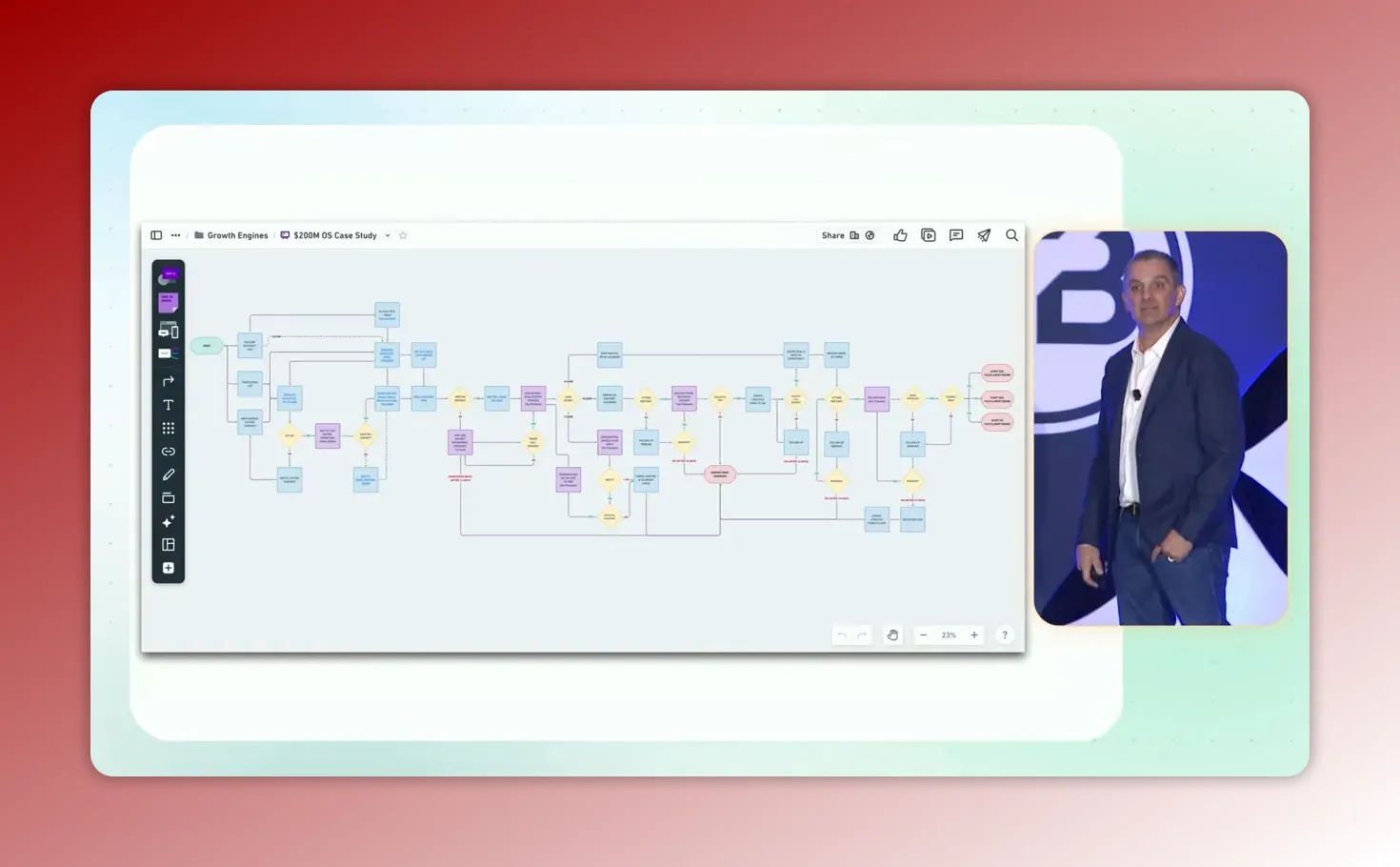
After stakeholder review, digitize the map. Use a tool like Whimsical, Lucidchart, or Miro. The digital version becomes your playbook. Share it with the team and attach SOPs, templates, and scripts to the relevant nodes.
Start simple. Your first diagram will look like a handful of sticky notes. Over time, as you add optimizations, it becomes richer. But always resist the temptation to overcomplicate. Simplicity scales. Complexity slows execution and hides the chain of value.
From growth engines to fulfillment engines
A growth engine ends when the sale is made. The second half of the customer journey is the fulfillment engine. A fulfillment engine begins where the growth engine ends. Stack them together and you have the full customer journey—from cold prospect to delighted customer.
Map fulfillment separately but with the same rigor. What happens after the contract is signed? What onboarding steps, customer success touchpoints, product delivery milestones, and cross-sell opportunities exist? Mapping fulfillment closes feedback loops and creates new optimization opportunities for the growth engine.
Optimization principles for strategy and operations alignment
Once the engine is visualized, you can optimize intelligently. Here are the guiding principles I use repeatedly:
- Resist complexity. Complexity occurs naturally. Your job is to simplify. Simplicity scales.
- Value chains, not single drivers. Growth is created by a chain of activities. Master the chain rather than obsessing over a single tactic.
- Visualize before you optimize. You cannot improve what you do not first visualize. Mapping is the precondition for meaningful optimization.
- Measure what matters. Identify the handful of metrics that indicate movement through the engine: opt-in rate, webinar show rate, demo-to-close, call-to-book, cart conversion, upsell take rate, and fulfillment completion.
- Make micro-commitments visible. Calendar and wallet commitments are the best predictors of future purchases—webinar attendance, demo show-ups, scheduled appointments, and paid trials.
Practical checklist to build your first growth engine
- Pick one flagship product or service to focus on. This keeps the work tractable and impactful for strategy and operations alignment.
- Define the start (triggering events) and end (signed contract or fulfilled order).
- Inventory channels and content assets that actually exist today.
- Map every stage and decision diamond on sticky notes. Ask "then what?" until you reach the end.
- Identify orphan tasks and reconnect or remove them.
- Run a stakeholder review to validate the map and fill gaps.
- Digitize the map in a flowchart tool and attach SOPs and templates to each node.
- Stack the growth engine and fulfillment engine to document the full customer journey.
- Prioritize optimizations based on impact and implement them one at a time.
Common mistakes and how to avoid them
Teams often make the same mistakes when building growth engines. Here is how to avoid them and keep your strategy and operations alignment intact.
- Mistake: Mapping what should be instead of what is. Document reality first. Optimizations come later.
- Fix: Observe current data and ask the team what they actually do. Then diagram it.
- Mistake: Too much detail in the first pass. You do not need an SOP-level diagram to start.
- Fix: Map stages and decisions. Store SOPs separately and link to them from the diagram.
- Mistake: Ignoring off-line channels. Brick-and-mortar businesses or radio ads still belong in the engine if they trigger customer behavior.
- Fix: Represent offline triggers and inbound calls just like any other channel.
- Mistake: Failing to run a stakeholder review. Without it you miss orphan activities and lose team buy-in.
- Fix: Make stakeholder reviews mandatory and treat the map as a living document.
How to prioritize improvements once the map exists
With the engine visualized, improvements fall into two categories: quick wins and strategic bets. Use a simple prioritization matrix: impact versus effort.
- Quick wins: Low effort, high impact. Examples include adding a cart abandonment sequence or adding nurture flows for challenge opt-ins who never click.
- Strategic bets: High effort, high impact. Examples include building a new webinar funnel or launching a productized service for higher lifetime value.
Always test one hypothesis at a time and instrument it. A clear map ensures you know what to measure and where an experiment will affect the chain. That is the essence of strategy and operations alignment: every experiment maps to a measurable place in the engine.
How to scale the mapping practice across your organization
Once you have one growth engine mapped, replicate the practice. Teach each product owner or business unit to produce an engine. Create a central repository so leaders can see how engines intersect and where shared resources should be allocated.
This federated approach prevents duplicated work and aligns the organization around the value chains that matter. Over time, you will build a portfolio of engines and a rubric to evaluate which engines deserve more marketing spend, sales headcount, or product investment. That is strategy and operations alignment at the portfolio level.
Cheat sheet: The growth engine in six steps
- Inventory growth assets with the six questions above.
- Select one flagship product and commit to mapping it end to end.
- Define your START and END terminus points.
- Brainstorm every stage, micro-commitment, decision, and follow-up.
- Hold a stakeholder review to capture orphan tasks and validate the map.
- Digitize and attach SOPs, then prioritize optimizations.
Closing: why documenting how customers happen is non-negotiable
Never underestimate the power of simply documenting how customers happen in your business. A growth engine converts assumptions into a repeatable and improvable process. When your marketing, sales, and fulfillment teams share a single visual map, you achieve true strategy and operations alignment: the work becomes coordinated, measurable, and scalable.
Build your first growth engine now. Start with a whiteboard and sticky notes. Be brutally honest about what actually happens. Run the stakeholder review and commit to continuous improvement. In weeks you will find obvious optimizations. In months you will unlock sustainable scale. Strategy and operations alignment will follow—naturally, predictably, and profitably.
"Visualize to optimize. You cannot optimize what you cannot first visualize."
If you take one action today: pick one flagship product, draw a START pill in the upper left, and ask, how do customers happen? That single question will change where you spend your time and will begin aligning strategy and operations in your organization.
Tools and resources
If you plan to publish and share your digitized map, consider reliable website hosting and builders—try website hosting to set up a central repository and public playbook.


