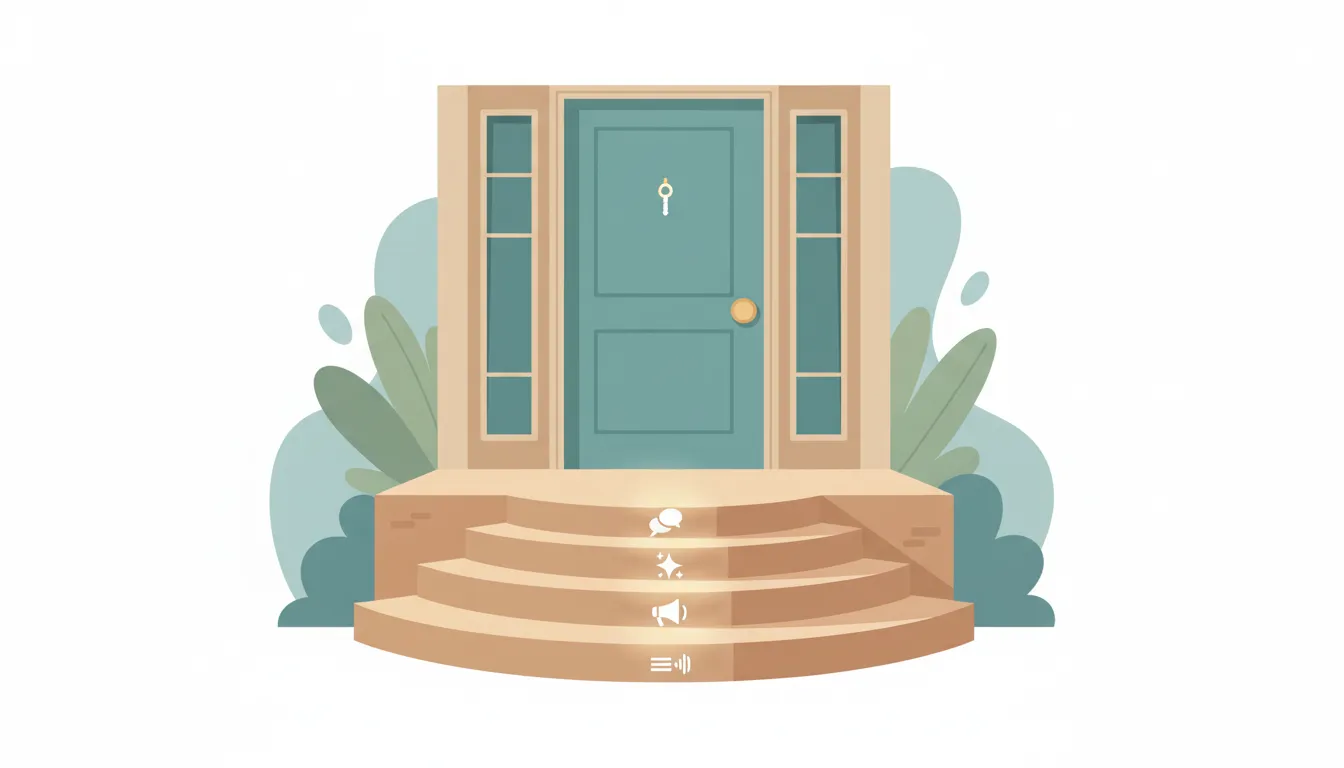
If your marketing rarely cuts through, it's probably not because your product is weak. It's because your words are weak. You need a set of short, repeatable soundbites — the five front steps that lead strangers to your front porch and invite them inside. When those five lines are crisp, a business suddenly becomes easier to explain, easier to sell, and far simpler to scale.
Why five soundbites? The house metaphor that changes everything
Think of your business as a house. The porch and the front door are where education, trust, and conversion happen. But most companies forget the front steps — the simple, repeatable lines that get people curious enough to climb up. Those front steps do one job: create curiosity without requiring thought.
The front steps are not a place for nuance or a detailed product demo. They are not where you teach how the engine works. They are a short, consistent set of phrases that move a person from "maybe" to "tell me more." When you get those phrases right, customers stop in their tracks and ask for the next step.
The PEACE framework: five soundbites that form a story
The framework to build these front steps spells P-E-A-C-E. Each letter is one soundbite and, together, they form a simple story: Problem → Empathy → Answer → Change → End Result.
Rules for these soundbites
- Do not be nuanced. These must be black-and-white, instantly understandable lines.
- Be short and memorable. Bumper-sticker logic that a four-year-old could repeat.
- Invite people into a story. The soundbites should paint the customer as the hero in a hole who needs a guide.
- Position yourself as the guide. Never the hero. Make the customer the hero and your product the rope.
- Repeat them everywhere. Ad copy, pitch decks, onboarding emails, user interface copy — these lines must be pervasive.
Breakdown of each soundbite
1) Problem — Hook attention with a universal but specific problem
The first soundbite is a hook. It identifies the problem your customer experiences. The trick is to make it broad enough to include almost everyone you want paying attention but sharp enough that those in pain feel it personally.
Example: For the budgeting app YNAB the problem line is: Have you ever worried about money?
Why that works: "Have you ever" captures everyone who has ever felt the pain, which is basically everyone. If someone is actively worrying about money, they stop immediately. If they’re not, they still recognize the question and are curious. That universal entry point drives scale.
2) Empathy — Make people feel seen
The second soundbite is simple: an empathetic acknowledgment. This is the guide leaning over the hole and saying, "I feel you. I know how that hurts." That connection creates trust in eight words or fewer.
Example: YNAB’s empathy line is: We know how you feel.
It’s not a long empathy paragraph. It’s a quick human bridge from problem to solution. When people feel understood they are open to listening to how they might climb out.
3) Answer — Throw the rope
Now the guide offers a rope. This is where you name your product or the specific next action. Keep it tactical and direct. No explaining how the rope is woven; just throw it down.
Example: Download the YNAB app.
Viewed sequentially the three lines form a short narrative: "Have you ever worried about money? We know how you feel. Download the app." If someone recognizes the problem and trusts the empathy, that instruction becomes far more valuable.
4) Change — Articulate the transformation
The fourth soundbite explains what changes for the customer after using your product. This is the identity shift they want. Good change lines are aspirational and short.
Example: YNAB’s transformation line became their tagline: Get good with money.
That four-word line is powerful because it becomes an identity: people want to be "good with money." The change should be desirable enough that someone is attracted to the identity.
5) End Result — Show what life looks like
The final soundbite paints the climactic scene: life after the climb. This is not about features. It is the emotional and practical payoff.
Example: YNAB’s end result: You'll never have to worry about money again.
Put all five together and you have a single short sentence that invites a customer into a narrative pathway from pain to resolution:
Have you ever worried about money? We know how you feel. Download the YNAB app and get good with money, so you'll never have to worry about money again.
Why this structure works (psychology + storytelling)
Every story features a hero in a hole who must climb out. The five soundbites recreate that structure in 30 seconds or less: identify the hole, show compassion, offer a rope, describe the transformation, and illustrate the climactic life beyond the hole.
Two psychological levers at play:
- Recognition of pain increases perceived value. When people see their problem clearly described, a product suddenly becomes far more valuable.
- Empathy reduces resistance. Knowing someone understands you lowers the barrier to accept the offered solution.
Quick examples you can steal and adapt
Below are short, adaptable templates. Use the problem as your hook, add a one-line empathy, state the action, name the transformation, and conclude with the end result.
-
Problem: Ever dread tax season?
Empathy: We get how messy it feels.
Answer: Use [Your App Name].
Change: Get tax-ready in minutes.
End Result: Never fear filing again. -
Problem: Struggling to find reliable volunteers?
Empathy: We know how exhausting recruiting is.
Answer: Try our volunteer platform.
Change: Build a dependable team.
End Result: Run events without the last-minute panic. -
Problem: Is donor retention falling year over year?
Empathy: It’s heartbreaking to lose supporters.
Answer: Adopt our stewardship toolkit.
Change: Keep donors engaged.
End Result: Fund your mission with predictable income.
How to discover your five soundbites (a practical workshop)
This is not an instant brainstorm exercise. It requires disciplined choices and testing. Use the following process to arrive at front-step language that works.
Step 1 — Stop describing features
The first rule is to stop explaining the product. A rope is not described in detail on the porch. It's thrown down. Replace features with outcomes and identities.
Step 2 — Identify the hero's hole
Gather your team and answer: what is the single problem our customers feel most painfully? Phrase it as a question whenever possible. Questions invite attention and reduce defensiveness.
Step 3 — Write 3 versions of each soundbite
For each P, E, A, C, and E, write three short alternatives. Keep them under eight words. Test which version invites the strongest reaction when you say it aloud to strangers.
Step 4 — Assemble short combos and test live
Put a Problem, Empathy, and Answer together and read it at a networking event or casual conversation. If people ask "Can you tell me more?" you've succeeded.
Step 5 — Lock your controlling idea
One of these five soundbites should become your controlling idea or tagline. It is the single moral of the story you want customers to remember. Keep everything else tied to that line.
Where these soundbites live — distribution checklist
A soundbite is useless if it only lives in a doc. The point is to repeat it everywhere. Treat it like a campaign that requires discipline.
- Website header and hero copy
- Meta ads and search ads
- Social posts and short-form videos
- Sales scripts and voicemail intros
- Onboarding emails and in-product UX copy
- Pitch decks, proposals, and business cards
- Internal staff meetings, training, and the end-of-session repeatable line
Example of running it like a campaign: Chick-fil-A chose to say "my pleasure" instead of "you're welcome." That decision had to be enforced for years to become a habit across every location. Your soundbites need similar commitment.
How these soundbites scale revenue and internal morale
When a business communicates clearly, several things happen at once:
- Sales increase: Customers understand the value faster and convert more often.
- Pricing power increases: When the problem and transformation are clear, you can charge premium prices for premium outcomes. (Example: a gym charging $90 for membership might charge $1,000 for a "10 Years Longer" cohort because the identity shift justifies it.)
- Internal clarity: Employees understand the impact they have and speak the same language. That boosts morale and consistency.
Troubleshooting common mistakes
Mistake: Putting your story first
Many companies start with their origin story. That’s fine, but put it in the right place. The story of why you started matters to paying customers only after they recognize the problem. If you lead with your origin you risk sounding irrelevant.
Mistake: Over-explaining on the porch
If your landing page is a lecture on how the sausage is made, your front steps have failed. Keep porch copy short and move explanation behind the door: webinars, guides, and demos.
Mistake: Not repeating enough
A soundbite only works when repeated. Decide where you will repeat the line and schedule the repetition. Train staff to use the same words at events, calls, and customer touchpoints.
Practical templates and quick scripts
Use these plug-and-play scripts for common settings. Fill in the bracketed phrase with your specific phrase.
Elevator pitch (8–15 seconds)
Have you ever [problem]? We know how that feels. [Action — download, sign up, schedule a call] and [change], so you'll [end result].
Networking version (casual)
"I work with [target audience] who [problem]. We [empathy]. The quickest way to start is [action]. People who use it usually end up [change]."
Ad headline + subhead
Headline: Have you ever [problem]?
Subhead: We know how you feel — [action] so you can [change] and
[end result].
Small nonprofit and small business adaptations
This framework scales down cleanly for organizations with limited budgets. The words are free. A small nonprofit can use the same five soundbites to improve donor conversion, volunteer recruitment, and program sign-ups.
Tips for small organizations:
- Use empathy to connect donors: "Have you ever felt like your gift didn't make a difference? We know how that feels. Join our monthly donors and see the change."
- Make an obvious call-to-action: "Give today" or "Sign up to volunteer" are perfectly fine A lines.
- Measure one metric: Pick a single metric (donor retention, event RSVPs) and test which problem/empathy lines drive the best lift.
- Train your team: Teach staff and volunteers the three lines to repeat at every interaction: problem, empathy, and action.
One-week sprint to produce your five soundbites
If you want to lock these down in seven days, follow this sprint:
- Day 1: Workshop — define the single problem (90 minutes).
- Day 2: Craft three versions of each soundbite (2 hours).
- Day 3: Quick live tests — tell strangers two-line combos and record reactions.
- Day 4: Pick your controlling idea and draft one-line tagline.
- Day 5: Choose primary channels and write sample ad/headline copy.
- Day 6: Implement in one place: website hero or onboarding email.
- Day 7: Review early performance and iterate.
Examples of soundbites in real language (copy you can steal)
YNAB (budgeting app)
- Problem: Have you ever worried about money?
- Empathy: We know how you feel.
- Answer: Download the YNAB app.
- Change: Get good with money.
- End Result: You’ll never have to worry about money again.
Gym owner (specialized cohort)
- Problem: Worried about your longevity as you get older?
- Empathy: We’ve watched good people lose years to preventable decline.
- Answer: Join our 10 Years Longer cohort.
- Change: Add a decade to your healthy life.
- End Result: Play with your kids and grandkids without running out of breath.
How to know if your soundbites are working
Measure impact with simple indicators:
- Do strangers ask, "Can you tell me more?" after hearing the line?
- Do your ads or landing pages see improved click-through rates when the new lines are used?
- Do prospects convert faster in sales conversations where reps use the soundbites?
- Have employees adopted the language across touchpoints?
Final encouragement — discipline matters more than brilliance
Finding the words is hard. The hard part is leaving everything else out and being disciplined enough to repeat the lines everywhere. If you treat this like a political campaign — memorize the soundbites and deploy them by role and channel — your organization will gain clarity, momentum, and revenue.
Words are free and they scale. When you put the right five soundbites into circulation with intention and repetition, the business begins to grow without expensive pivots or flashy gimmicks.
FAQ
What specifically are the five soundbites I should create?
Create one short line for each of these: Problem, Empathy, Answer, Change, End Result. Keep each line simple and repeatable. Example set: "Have you ever worried about money? We know how you feel. Download the app. Get good with money. You'll never worry about money again."
Can small nonprofits use this framework?
Yes. Nonprofits benefit because words are free. Use a problem line that highlights the community pain, an empathy line that shows you care, an action line (donate, volunteer, sign up), a transformation line (what the donor helps create), and the end result (the long-term impact).
How do I pick the controlling idea or tagline?
One of your five soundbites should be the controlling idea. Choose the one that best captures the moral of your story — the identity change you want your customer to claim. Test it in conversation and pick the line that generates the strongest emotional reaction.
Where should I start implementing these soundbites?
Start in one visible place: the website hero, a paid ad, or the first onboarding email. Then train your team to repeat the language across all customer touchpoints. Measure reaction and iterate quickly.
How long will it take to see results?
You can get meaningful signals in days from live tests and ad performance. Bigger revenue and brand shifts generally show in months because your language needs to saturate channels and become habitual for staff.
Closing note
The five soundbites are the simplest high-leverage work you can do for your messaging. They are a tiny set of words that shape everything else: ads, onboarding, sales, and culture. Pick a problem your audience truly feels, say you understand, hand them a clear next step, promise a desirable change, and show the life beyond the problem. Repeat those lines every day.
If you treat these soundbites like a campaign and enforce their use, they will change how people hear you, how employees talk, and ultimately how customers pay.
This article was created based on the video 5 Soundbites That Made This Company Millions (Copy This Framework).


