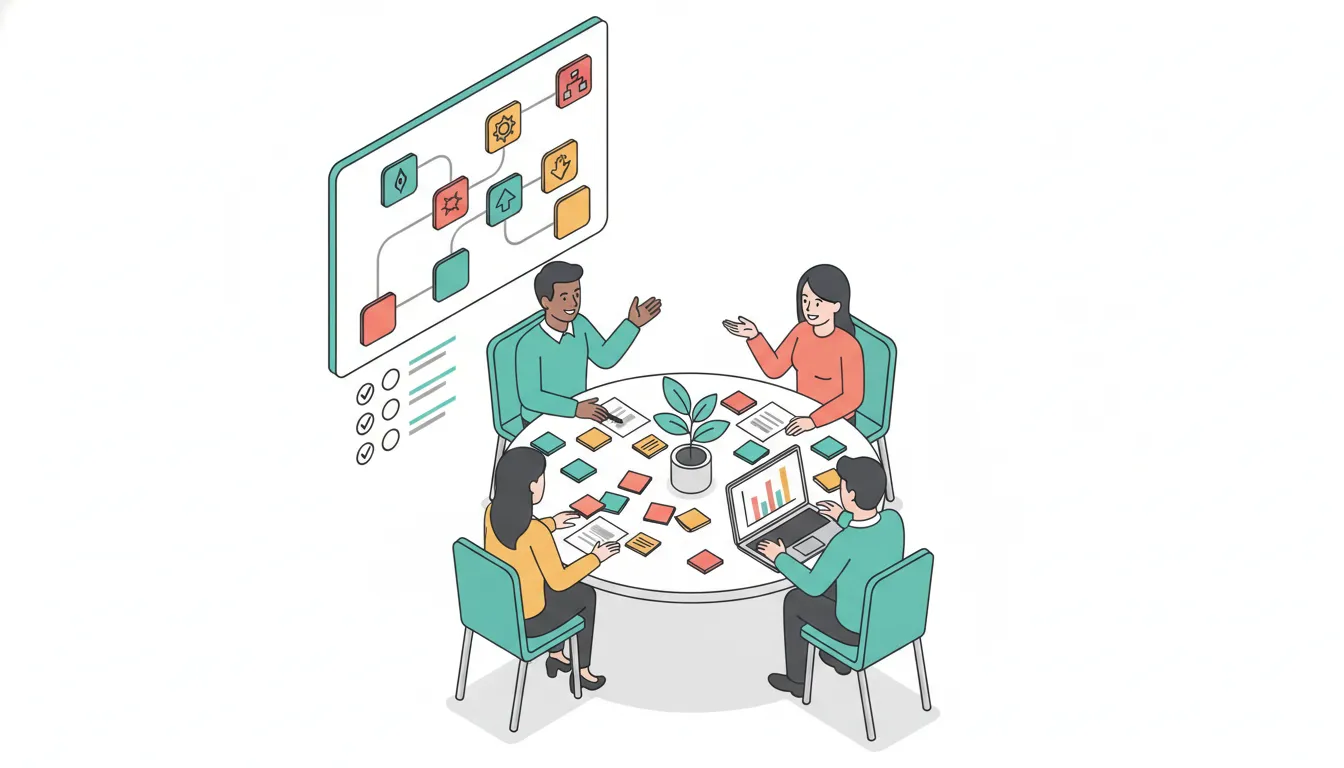
I’ve spent my career inside product teams at Google, Twitter, Yahoo, and Stripe. Along the way I learned the same few lessons over and over: small changes in how you think and run meetings produce huge differences in outcomes. I want to share five of the most practical, repeatable ideas I use with teams — plus a bonus — and frame them for organizations that don’t have enormous engineering teams or budgets: small businesses, volunteer-run nonprofits, and scrappy mission-driven teams.
This is not theory. These are rituals, mental models, and allocation rules that scale to teams of one up to fifty. Use them to spend less time reacting and more time shaping outcomes.
Quick overview (what to expect)
- Pre-mortems: A low-cost ritual that prevents obvious mistakes and creates permission to speak up.
- LNO framework (Leverage, Neutral, Overhead): A simple way to prioritize your time and energy.
- The three levels of product work: Impact, Execution, Optics — and why misalignment causes so much friction.
- Execution problems that aren’t execution problems: Most execution pain traces back to strategy, culture, or people.
- Opportunity-cost thinking vs ROI thinking: Why your spreadsheet of “positive ROI” tasks is a trap.
- Bonus — High agency: The single behavioral trait that multiplies results on small teams.
1. Pre-mortems: predict and prevent predictable failures
Most teams know how to run post-mortems: when something breaks, gather people, scan for root causes, and write down fixes. Post-mortems are useful, but they are reactive and often costly. A pre-mortem is the opposite. It is a structured conversation you run early — when the cost of preventing failure is small and the value of awareness is large.
What a pre-mortem actually is
A pre-mortem starts with a simple rhetorical move: imagine our project failed spectacularly six months from now. What caused that failure? That single prompt unlocks candor and creative problem finding. People suddenly feel license to voice concerns that otherwise vanish in status-driven meetings.
Why it works
- Psychological safety: Framing the conversation around a hypothetical failure makes it okay to be “negative” for a bit. People are more willing to surface inconvenient truths.
- Shared vocabulary: If your team uses terms like tiger, paper tiger, and elephant, you can talk about risk faster and less defensively.
- Low cost, high upside: It’s one meeting plus a prioritized action plan. It prevents far more costly cleanup later.
Three things each person brings: tiger, paper tiger, elephant
- Tiger — a risk that could actually kill the project (e.g., a regulatory issue that would force the product offline).
- Paper tiger — a risk others worry about but which you think is unlikely or overrated (e.g., a slightly delayed vendor deliverable that won’t block launch).
- Elephant — the thing nobody is saying out loud but everyone kind of knows (e.g., “we assume donors will respond to this messaging, but we haven’t tested it”).
How to run a pre-mortem (practical script for small teams)
- Invite everyone who will touch the project. On a small nonprofit that might be the director, a volunteer coordinator, one developer, your comms person, and a board member. For a small business it might be founder, lead marketer, customer success, and developer.
- Set the stage: read the prompt out loud — “Imagine this has failed badly six months from now.”
- Quiet time (5–10 minutes): everyone writes down three items (tiger, paper tiger, elephant) privately in a shared doc or on sticky notes.
- Round-robin sharing: each person reads their items. No discussion yet—just collection.
- Voting: ask each person to pick the single tiger they fear most from someone else’s list. This surfaces which risks are broadly scary.
- Prioritize and assign owners: create a short action plan. Pick 2–3 mitigations to execute within two weeks.
- Follow-up: make the owner accountable. Include progress in the next status update.
On a small team you do not need an elaborate doc tool. A simple shared note or spreadsheet will do. If you want a template, you can start with the Coda pre-mortem template I used internally: https://coda.io/@shreyas/pre-mortems-how-a-stripe-product-manager-predicts-prevents-probl
Examples tailored to small organizations
- Small business launching an e-commerce feature: tiger = tax compliance for new jurisdictions; elephant = we assume shipping partners will scale on holidays.
- Nonprofit launching a donor portal: tiger = donor data leak; paper tiger = concern over a minor UI color decision; elephant = board won’t adopt the new reporting cadence.
Running 30–60 minute pre-mortems before any important initiative will pay back immediate risk reduction and build a culture where people speak up early.
2. The LNO framework: how to get the most out of your limited time
Everyone in a small organization has finite time. That makes prioritization both more vital and easier: you can have huge impact by simply choosing differently. The LNO framework gives you three buckets to judge each task.
L, N, and O explained
- L — Leverage: tasks where a small amount of effort multiplies into 10x or 100x impact. These are the things worth perfection and deep focus.
- N — Neutral: tasks where you get roughly what you put in. They are necessary but not transformative.
- O — Overhead: chores that consume a lot of time and return very little impact.
Key insight
Most people and organizations treat all tasks the same. The trick is to treat them differently. Spend most of your best time on L tasks, shortcut O tasks, and automate or delegate as many N tasks as reasonable.
How to identify L tasks
L tasks are the things that keep you up at night because you aren’t doing them — strategy, a difficult product decision, or aligning two teams to unlock a partnership. They are the work you know matters but also the work you tend to procrastinate on because it is hard or risky.
Practical examples for small orgs
- Small business: L task = building the subscription billing flow that converts visitors into recurring customers. N task = weekly inventory sync. O task = beautifying internal expense reports.
- Nonprofit: L task = creating a donor stewardship strategy that doubles repeat giving. N task = publishing the monthly newsletter. O task = perfect formatting of a volunteer sign-up sheet.
Turn procrastination into progress
Two tactics that helped me and many PMs are particularly effective:
- Placebo productivity. For two days before a planned L task, do a set of N and O activities intentionally. They create a sense of motion and let you “earn” the time to tackle the real thing. This reduces the guilt that sometimes keeps you procrastinating.
- Change your location. Work on the L task from someplace different: a coffee shop, a library, or a quiet room. The physical change nudges the brain into focus and signals to others you’re in deep work mode.
How to shift your calendar
If you run a team, protect a block of uninterrupted time for the person who owns the L task. For a one-person operation, create a recurring weekly block you defend fiercely. L work requires sustained attention; short bursts rarely do it justice.
3. The three levels of product work: impact, execution, optics
Conflicts on teams often aren’t about competence or effort — they are about levels of thinking. When people operate at different default levels you get unproductive arguments, stalled launches, and misaligned expectations. Make the levels explicit and you reduce friction instantly.
The three levels
- Impact: What change are we trying to produce? Which users or beneficiaries will be measurably better off?
- Execution: What concrete steps, milestones, and tasks will ship the outcome? Who will do what and when?
- Optics: How do we create awareness and alignment internally and externally? How do stakeholders perceive our progress?
Why the mismatch matters
Imagine you’re presenting a launch plan to the board or CEO. You’re focused on execution details — timelines, resource constraints, and test plans. The CEO is thinking at the impact level: will this move the needle for customers or donors? If you don’t explicitly surface the impact, the review goes sideways. You argue details while the reviewer worries about outcomes.
How each level shows up in small organizations
- Impact: founder asking whether a new feature will increase repeat purchases or donor retention.
- Execution: the person building the feature outlining the integration steps, testing, and deployment plan.
- Optics: the communications person planning how to announce the change so stakeholders know what to expect and how to help.
Practical rule
Agree, explicitly, which level the team should be optimizing for in a given period. Early-stage projects usually optimize for execution. Strategic or fundraising initiatives optimize for impact. Platform or infrastructure teams may need to invest heavily in optics because their reliability affects many downstream teams.
How to use this model
- At the start of a project, label the dominant level: Impact, Execution, or Optics.
- Ask each stakeholder to state their level. If someone is operating at a different level, pause and reconcile.
- Use the label when something stalls: “Are we debating execution details or questioning impact?” Naming it redirects the conversation to the right place.
4. Most execution problems are strategy or culture problems
When I became a leader, I noticed a pattern: teams filled with talented people still got stuck. The symptom looked like execution failure, but the cure wasn’t more meetings or stricter processes. The underlying causes were usually strategy, culture, or interpersonal issues.
Common misdiagnoses
- Misalignment of strategy: Teams pull in different directions because they don’t share the same north star. The resulting “execution problem” is actually confusion about priorities.
- Perverse incentives and culture: If team performance is assessed purely on narrow OKRs, people will optimize for their metric instead of the company’s collective outcome. That creates friction when cross-team cooperation is needed.
- Interpersonal problems: Two managers simply don’t get along. No amount of process will fix poor collaboration if the underlying relationship is toxic or unproductive.
A diagnostic trick: the band-aid test
If you try a meeting cadence or a process change and the same problem reappears after a few months, you probably applied a band-aid to a strategic or cultural wound. Execution fixes are temporary if the root cause is deeper.
How to decide what’s wrong
- Ask whether people disagree about the goal. If yes, it’s a strategy problem.
- Ask what behaviors are being rewarded. If individual metrics trump joint success, it’s a culture design issue.
- Observe interactions. If conversations become personal, it’s an interpersonal problem and needs coaching.
Fixes that work in small settings
- Strategy problem: Run a short alignment workshop and create a one-page strategy document. Make it public and simple. For a nonprofit, align on which program outcomes matter most this year. For a small business, agree the single customer metric to move.
- Culture problem: Adjust incentives and recognition. Publicly praise people who sacrifice short-term OKRs to help the mission. Introduce cross-team performance goals.
- Interpersonal problem: Coach the managers. Set a short probationary alignment plan with clear behaviors and checkpoints. If coaching fails, reassign roles quickly; grudges compound and harm morale.
5. Prioritization: minimize opportunity cost, don’t chase ROI
Traditional prioritization asks, “Which tasks give the highest ROI?” In high-leverage roles the ROI trap is real: if you chase the ratio, you end up doing lots of small quick wins that inflate short-term efficiency but miss transformational opportunities. Instead, think about opportunity cost.
ROI vs opportunity cost — the difference
ROI thinking values tasks where value divided by effort is highest. That naturally favors quick, obvious wins. Opportunity-cost thinking asks if the work you chose is the best possible way to spend your limited time. It forces you to compare what you did with what you could have done instead.
Why opportunity-cost thinking matters for small teams
When resources are scarce, every hour spent on one thing is an hour not spent on something else. A single well-chosen bet can change your trajectory. For a small nonprofit, that might be investing in donor retention strategy rather than a dozen one-off campaigns. For a small business, it might be building a payment flow that unlocks subscriptions rather than polishing the site's homepage.
How to practice opportunity-cost thinking
- During planning, ask: If we had to choose one thing to double down on, what would it be and why?
- Limit big bets. I often recommend a rough allocation to help teams: 60% incremental, 30% big new initiatives, 10% stability. Adjust for your context. The key is to reserve room for one or two big, uncertain bets.
- Don’t try to numerically calculate opportunity cost. It’s an abstract, counterfactual idea. Use judgment and champions to protect the time.
Practical example
Say you have five clear incremental improvements each worth modest gains and two ambiguous ideas that could be huge but need exploration. If you pick the five incremental tasks you will fill the quarter with positive ROI items and feel busy. If one of those ambiguous ideas turns out to be a major revenue or impact driver, the opportunity cost is enormous. Reserve breathing room to explore the ambiguous, high-opportunity work.
Bonus: High agency — the trait that multiplies results
High agency is the behavior pattern that distinguishes people who consistently exceed expectations in resource-constrained environments. It’s not talent alone. It is a mindset and set of habits that you can cultivate across a small team.
Three components of high agency
- Ownership: they treat the outcome as their responsibility. They don’t wait for perfect conditions.
- Creative execution: they invent ways to move forward despite constraints. That could mean leveraging volunteers, using existing tools in new ways, or convincing a partner to swap resources temporarily.
- Resilience: setbacks don’t derail them. They adapt and iterate until the outcome improves.
How to hire, coach, and encourage high agency on small teams
- Hire for signals. Ask candidates for concrete examples of when they turned a bad situation into an outcome. Small teams can’t afford excuses.
- Reward behavior, not just output. Publicly acknowledge people who fixed a broken process or convinced a partner to contribute time. Those wins are often invisible but high-leverage.
- Model high agency. Leaders who push through constraints without blame set the culture. If leaders constantly blame “lack of resources” you get permission to avoid responsibility.
Putting these ideas together: a playbook for small businesses and nonprofits
Here is a simple, repeatable playbook you can adopt in the next 30 days. It combines the frameworks above into practical routines.
- Run one pre-mortem for your next important initiative (product launch, campaign, membership portal). Use tiger/paper tiger/elephant. Pick 2–3 mitigations and owners.
- Classify your backlog using LNO. Identify the three L tasks and protect the top L task each week with a 2–4 hour focus block.
- Label level of work (Impact/Execution/Optics) at the start of all quarterly priorities. Make sure everyone knows whether the quarter emphasizes execution or impact.
- Diagnose recurring execution pain using the band-aid test. If band-aids keep failing, dig for strategy, culture, or interpersonal problems.
- Reserve time for big bets. Set a rule like 60/30/10, then protect the 30% for one or two exploratory projects.
- Coach for high agency. In one-on-ones, ask about barriers and what the person did creatively. Celebrate the resourceful solutions.
Common pitfalls and how to avoid them
- Premortem without follow-up. The meeting is only useful if owners act. Capture a short action list and check progress weekly.
- Mislabeling L tasks. Not every “hard” task is L. Make sure the leverage outcome is clear and measurable before dedicating long stretches to it.
- Over-investing in optics. Visibility helps, but if optics becomes the goal you’ll starve real work. Use optics to amplify impact, not replace it.
- Over-engineering prioritization. Don’t try to quantify opportunity cost precisely. Use allocation rules and judgment.
Examples in the wild (mini case studies)
Small bookstore launching a subscription club
Problem: The owner wanted recurring revenue. The team filled the backlog with quick site UI fixes (positive ROI) while ignoring a subscription flow that required payment integration and shipping rules.
Applied changes:
- Pre-mortem surfaced a tiger: tax rules for recurring shipments.
- LNO reclassified the payment flow as L. The owner protected deep work time and outsourced overhead tasks like invoice formatting.
- Opportunity-cost thinking bumped the subscription flow ahead of five incremental tasks. Three months later recurring revenue covered 30% of revenue.
Small nonprofit launching an online donor portal
Problem: Fundraising was flat; the team debated many tactical campaigns. Volunteers felt overwhelmed and conflicted.
Applied changes:
- Pre-mortem revealed elephants: board hesitation about changing reporting cadence.
- Strategy alignment clarified that donor retention was the top impact metric. Execution work focused on donor journeys rather than one-off appeals.
- High agency behaviors were recognized: a volunteer who created a low-cost email nurture sequence was promoted to lead that stream, freeing staff to do L work.
Where to go from here
If you run a small business or nonprofit, pick one of these ideas and try an experiment for thirty days. Run a single pre-mortem. Reserve one afternoon per week for the team’s top L task. Label every project with Impact, Execution, or Optics. The compound effect of these small changes is what separates teams that feel busy from teams that actually move the needle.
How long should a pre-mortem take for a small team?
A compact pre-mortem for a small team can be 30 to 60 minutes. Spend 5–10 minutes on quiet individual ideation, 15–30 minutes sharing and voting, and 10–20 minutes creating a short action plan with owners. The goal is to leave with 2–3 prioritized mitigations and owners.
How do I classify a task as L, N, or O?
Ask three questions: 1) If I spend my best time on this, will it potentially create 10x or more impact? 2) Does it require sustained deep attention or is it routine? 3) Can I delegate or automate this task without harming outcomes? If yes to 1 and 2, it’s L. If it is routine and necessary, it’s N. If it mostly exists to complete paperwork or private polish, it’s O.
How can a small nonprofit implement opportunity-cost thinking without heavy analysis?
Use allocation rules. Agree as a leadership group how much time to reserve for incremental improvements (e.g., 60%), big bets (e.g., 30%), and stability (e.g., 10%). Protect the big-bet time and require a short one-page hypothesis for each big bet — then fund one or two for a quarter.
What if leadership only wants optics and status updates?
Optics matter but should not be the end goal. If leadership prioritizes optics, shift the conversation: show how better optics amplifies impact and helps secure resources. Create small, regular reports that link optics to concrete outcomes (e.g., how internal visibility led to faster staffing decisions or quicker donor approvals).
How do I build a culture of high agency on a volunteer team?
Make behaviors visible and safe. Celebrate creative problem solving publicly, give volunteers ownership with clear boundaries, and remove blockers quickly. Small wins matter: when a volunteer's initiative solves a problem, show the impact and offer a clear next step instead of asking for perfection.
Final thoughts
Small teams have two advantages: clarity and speed. Use clarity to decide what level to operate at, and speed to test one small change this week — a pre-mortem, a protected deep-work block for an L task, or shifting one metric to focus on impact. The frameworks above are intentionally simple because simple habits are the ones you can sustain when resources are tight.
If you try any of these ideas, track one outcome for the next 90 days: a conversion lift, fewer incidents, faster launch cadence, or higher donor retention. Small, measurable wins are the best proof that the frameworks work.
Where to find me online: https://twitter.com/shreyas and https://www.linkedin.com/in/shreyasdoshi/. If you found these ideas useful, share them with another small team — that’s the best way to make them spread.
This article was created based on the video The art of product management | Shreyas Doshi (Stripe, Twitter, Google, Yahoo).


